

13 Aug 2026
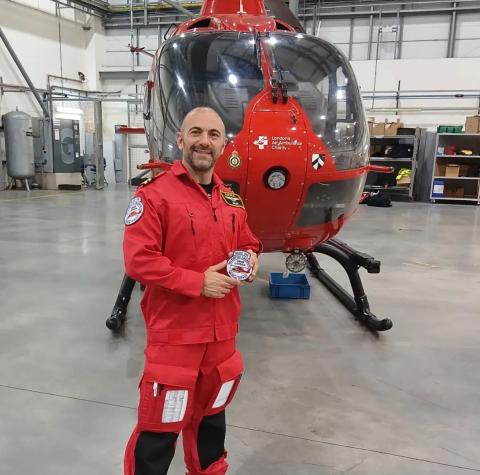
For Ewen, becoming a pilot has been a lifelong ambition. From visiting aviation museums as a child to recently joining London’s Air Ambulance Charity, his journey has been shaped by determination, resilience and a passion for flying.
Now, after completing his sign-off, Ewen has officially become a First Officer at London’s Air Ambulance Charity. To mark this special milestone, we asked Ewen to share more about his journey, reflect on his experiences as a HEMS pilot and share his advice for anyone dreaming of a career in aviation.
Congratulations on becoming a First Officer with London’s Air Ambulance Charity. What does receiving your badge mean to you?
Thank you! It's hard to put into words what it means to me. Not only have I worked really hard to achieve this milestone, it’s also given me a real feeling of belonging being a member of this special team. I feel like my flying skills mean something important, that in a small way, I make a difference and help the team in their live-saving missions.
Can you tell us about your journey to becoming a pilot and joining London’s Air Ambulance Charity?
I have wanted to be a pilot since I was three years old: what initially inspired me was that I liked pressing lots of buttons! My parents could see that I liked aircraft, so they regularly took me to Hendon RAF Museum and Elstree Aerodrome. For my bar mitzvah I received a lot of aeroplane trial lessons, which I quite enjoyed however, I wanted my flying to matter, for my flying to help people.
When I was 15, I went to an emergency services exhibition at Hendon RAF Museum, where were police helicopters, search and rescue and air ambulances. I can remember looking inside the 365 Dauphin – one of London’s Air Ambulance Charity’s first helicopters – and thinking ‘Yes, this is what I want to do’.
So, I aligned all my education to what I would need to be a pilot, from GCSE options to my degree in Aeronautical Engineering. I worked as an engineer for various aerospace companies, saving money for my Private Pilot Licence and all the subsequent courses.
I worked my way through to my Commercial Pilot Licence but couldn't afford to do the Instrument Rating. Instead, I did my flight instructor rating and worked for 14 years as a flight instructor, along with some charter flying. I really enjoyed teaching people to fly but I never lost sight of my goal and constantly worked on all my pilot skills.
Eventually, I managed to save enough for the Instrument Rating and was fortunate that London’s Air Ambulance Charity needed pilots just as I had qualified.
I didn't find any of my education or flight training remotely easy – I am quite severely dyslexic. But I had a dream: my determination and my passion for learning all things aviation kept me going, so I just kept slowly persevering.
You’ve recently completed your sign-off. What did the training involve and how did it feel to reach this milestone?
Having completed the type rating on the helicopter (H135T3H) and the Multi-Crew Cooperation course, there was a short course covering the operational role, including all the tasks before, during and after every mission and shift, along with landing on elevated helidecks.
Once that was completed, it was line training – literally flying the line, doing the co-pilot role but only flying with line training captains.
Once I was able to demonstrate all the skills and competences consistently, a date was set for a line check, which involved a shift where the training captain finally decides that you have met all the requirements.
I feel incredibly proud and privileged. It was a dream come true. It means I can call myself a HEMS First Officer and it’s a huge relief that all my hard work, persistence and resilience has paid off.
What’s it like working as part of London’s Air Ambulance Charity’s team? What’s the role of the pilot in supporting the clinical team?
It truly is a privilege. The skills and knowledge of everyone I work with are evident. Everyone takes a huge amount of pride in their role to deliver excellence and the teamwork is equally clear: respect, along with the camaraderie, is ever present no matter which pilots, medics and fire crew are on duty. We’re all working together with the same purpose and with the same dedication.
The main role of the pilots is of course to get the medical crew to the patient as quickly as possible, whilst maintaining their safety and the safety of the public. This involves navigating to find the scene and also the nearest but safest landing site, all with maximum efficiency. On scene, we may be needed to help carry equipment to the patient, but we also secure the helicopter and plan flights for refuelling and collecting the medics from various hospitals after they have handed over the patient. We have to be operationally ready for when the next call comes in.
Is there a particular flight, mission or experience from your time with London’s Air Ambulance Charity so far that has stayed with you?
We landed by the Wellington Arch, which was a safe but challenging site to navigate. The patient had been hit by a lorry while cycling with no helmet on. The clinical team had to administer lots of complex interventions, but as a result, the patient survived with good outcomes. It was a brilliant example of the life-saving work we do and the medics said had they not been flown there, there would have been very little chance of survival.
What advice would you give to someone interested in becoming a helicopter pilot, particularly in emergency medical services?
I have lived by the motto ‘giving up is not an option’. It has served me well and meant that no matter how difficult I found something, I kept on going. It also meant the achievements were even sweeter.
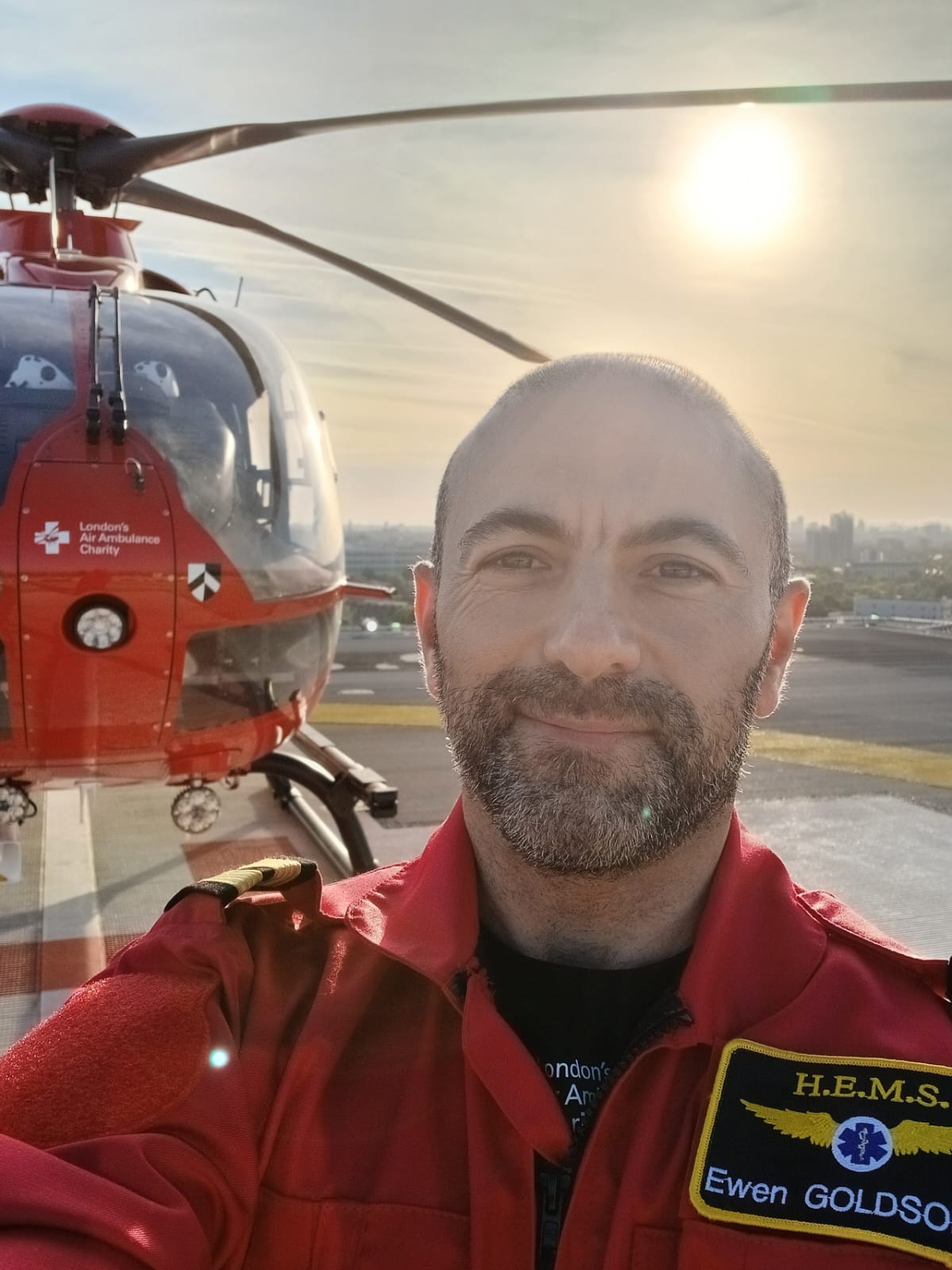
I would say visit lots of flying schools, do your research and think outside the box regarding how to reach your goal. Network, meet people, listen and learn. Study hard and value the theory as much as the practical. Enjoy every part of the journey, not just the successes – every mistake holds an important lesson and helps you grow into the pilot you want to be.
Be a role model, be a team player and work on your attitude as much as your aptitude.
For Ewen, becoming a First Officer at London’s Air Ambulance Charity represents much more than completing another stage of his training. It’s the culmination of a childhood ambition and years of hard work, persistence and resilience – and the beginning of a new chapter as a vital member of our team.