

19 Aug 2026
Back in March 2019, Louise was a mum to three children under nine, working as a GP, living a busy, healthy life. During a usual weekday morning – getting the kids ready to leave for school – as Louise walked down the stairs at home, she suddenly, unexpectedly, fell unconscious.
Her children could not wake her.
“Three weeks passed and I woke up in ICU, having had brain surgery,” said Louise.
On the stairs, Louise had suffered a spontaneous brain haemorrhage, due to an undiagnosed cerebral artery aneurysm. Often the first sign you have an aneurysm is after it bleeds (a subarachnoid haemorrhage).
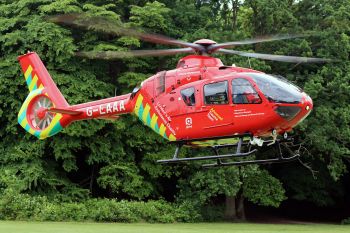
Louise’s eldest child quickly and bravely called a neighbour who was a close friend, who luckily was able to come around immediately. She called 999 and emergency services were dispatched, including London’s Air Ambulance by air. We landed in a nearby school.
On our arrival, Louise was already being attended to by London Ambulance Service (LAS) paramedics. She was unconscious and cerebrally agitated and the team suspected she had a non-traumatic bleed in her brain. Working with LAS, we sedated Louise, before placing her in a medically induced coma and connecting her to a ventilator.
“I was resuscitated in my doorway,” said Louise. “The immediate care that I received in my house is why I am here today. I know that if nothing had been done, I would have died at home that morning.”
Our team accompanied Louise to the nearest major trauma centre in a road ambulance, where she remained in ICU for three weeks.
 After enduring a few complications including chest infections and blood clots, over a couple of days Louise began to regain consciousness and her brain began to recover. Luckily, she did not have a stroke or serious brain damage, which can occur after a subarachnoid haemorrhage.
A month later, Louise was discharged home, but she was unable to walk properly. She had lost a lot of weight and muscle strength, suffered with severe fatigue and found dexterous tasks (like doing up buttons) a challenge. She also sometimes struggled to find her words and was often very shaky – she was unable to write properly.
“I had to be helped by everybody – friends, family and neighbours. But gradually, step by step, I did a bit more each week and I got better.”
Starting with 50m walks, then further distances, then tackling stairs, Louise concentrated hard on regaining her strength and her mobility. She also went through vocational rehabilitation, to practice her cognitive abilities.
“Rehab really helped me learn how to live with a brain injury. It does leave you with symptoms – I still get quite tired and you have to set boundaries. But it helped me be sure I could go back to work.”
Now, Louise is back at the GP surgery, treating and helping others as she was before. She’s also, of course, back at home with her husband and three children. She has made a remarkable recovery and is living a full life.
“Every year that goes by, I think about all the things I would have missed. Seeing my daughters grin and bear DofE expeditions, watching my son perform trombone on stage, parent’s evenings: so many everyday moments that my children wouldn’t have had me for.
“I’m so lucky the air ambulance team came to me – I wouldn’t have survived in the way that I have without them.”
A few years after the incident, Louise ran a half marathon to raise money for London’s Air Ambulance Charity – an incredible demonstration of just how well she has recovered.
 “For whatever reason I got a second chance at living. I appreciate life so much more now. I’m just really grateful and very lucky to have survived with very little that inhibits me.”
Every year, on the anniversary of the incident, instead of marking the unimaginable experience Louise’s family have gone through, they celebrate ‘Little Heroes’ Day’.
“My children played such a pivotal role in saving my life – so we celebrate them on the anniversary. It usually involves pancakes!
“I’m so grateful for all the moments we get to have together. Every birthday my children have, I’m thankful I get to be here to witness more of their lives.”
Sharing some advice for others who may be going through a similar experience, Louise said: “Don’t despair. Give yourself time. Be patient. Every day that passes, it’ll get a bit easier. Don’t try and rush things. Be gentle with yourself. Step by step you’ll get there. And when you have achieved something, look back at yourself and be proud.”